
Most mid-career professionals spend their job search energy in the wrong place. They polish their resume, post thought leadership content, and submit applications into the void, never realizing that a well-placed comment on a hiring manager's post can do more for their career than a hundred cold applications. Understanding why LinkedIn comments lead to jobs is not about gaming an algorithm. It is about recognizing that visibility, credibility, and warm relationships are built in conversations, not broadcasts. This article breaks down the exact mechanisms at work and gives you a practical framework to use them.
Table of Contents
- How LinkedIn comments build passive relationships that lead to jobs
- Why targeted engagement beats broad posting for recruiter visibility
- How your LinkedIn comments influence hiring decisions and reputational signals
- The critical role of tone: Avoiding negative impressions in LinkedIn comments
- Crafting strategic LinkedIn comments to maximize job opportunities
- Why most LinkedIn job seekers overlook comments — and what you should do differently
- Leverage AI-driven LinkedIn outreach to complement your commenting strategy
- Frequently asked questions
Key Takeaways
| Point | Details |
|---|---|
| Comments build warm connections | Substantive LinkedIn comments create a relationship context that improves connection and hiring success. |
| Targeted engagement matters | Recruiters notice participation in niche conversations and groups more than frequent broad posting. |
| Tone impacts reputation | Comments perceived as respectful and professional improve hiring impressions, while harsh remarks can backfire. |
| Comments affect hiring | Some recruiters use public LinkedIn activity to evaluate candidate fit and professional judgment. |
| Combine commenting with outreach | Pairing strategic comments with AI-driven LinkedIn outreach accelerates job search results effectively. |
How LinkedIn comments build passive relationships that lead to jobs
Most professionals treat LinkedIn like a billboard. They post, they wait, and they wonder why nothing moves. But the professionals who actually get calls from hiring managers are doing something quieter and far more effective: they are commenting.
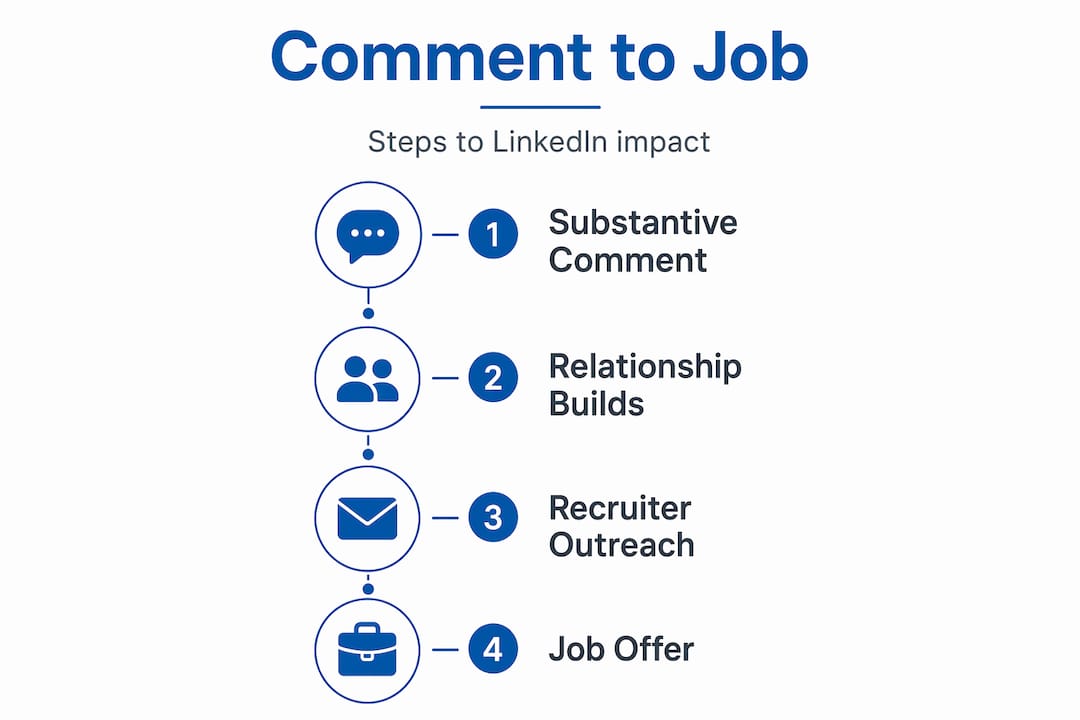
Comments can function as "passive relationship-building" during a job search. When you comment substantively on a hiring manager's post or a company's content, you signal expertise and genuine interest without submitting a cold application. You create context. And context is what transforms a cold connection request into a warm one.
Think about what this looks like in practice. A VP of Product at a company you want to join posts about the challenge of aligning roadmap priorities with revenue targets. You reply with a specific example from your own experience: a framework you used, a tradeoff you navigated, and the outcome. That comment is now visible to the VP, to everyone who engages with that post, and to anyone who visits your profile. You have not asked for anything. You have simply demonstrated that you belong in the conversation.
Here is what passive relationship-building through comments actually creates:
- Familiarity before contact. Hiring managers who recognize your name from prior comments are far more likely to accept a connection request.
- Proof of expertise. A comment with real specifics reads like a mini case study. It shows you can think, not just talk.
- A reference point. When you do reach out, you can mention your prior comment naturally, which removes the awkwardness of cold outreach entirely.
- Ongoing visibility. Leveraging LinkedIn profile activity consistently keeps you visible to the right people without requiring a new post every week.
The key word here is substantive. Generic comments ("Great post! Totally agree!") do nothing. They are invisible. A comment that adds a data point, challenges an assumption respectfully, or shares a concrete example is the kind that gets noticed and remembered.
Why targeted engagement beats broad posting for recruiter visibility
Here is a counterintuitive finding that should change how you spend your time on LinkedIn. Posting broadly to your feed, even consistently, may be generating far less recruiter attention than you think.
Engaging in LinkedIn conversations can lead to significantly more recruiter outreach because it changes where you appear in recruiters' monitoring habits. Recruiters do not just scroll the open feed. They monitor specific group threads, niche discussions, and comment sections on posts from companies and leaders they follow. When you show up there, you show up in front of the right people.

In a 2026 experiment, one professional stopped posting entirely for 30 days and redirected that energy into targeted group thread commenting. Recruiter outreach increased five to six times compared to the previous month. The reason is straightforward: group-thread replies are three to five times more visible to recruiters than open feed posts, because recruiters are actively scanning those spaces for talent.
| Activity | Recruiter visibility | Effort per week | Relationship-building potential |
|---|---|---|---|
| Open feed posts | Low to moderate | High | Low |
| Group thread comments | High | Moderate | High |
| Direct messages (cold) | Very low | High | Very low |
| Targeted substantive comments | Very high | Moderate | Very high |
Pro Tip: Identify three to five LinkedIn groups in your industry or function and spend 20 minutes per day commenting in active threads there. You will appear in spaces recruiters actually monitor, rather than competing for attention in a crowded feed.
The shift in mindset here matters. Posting is broadcasting. Commenting is participating. Recruiters are looking for people who are already embedded in professional conversations, not just people who publish content about them.
How your LinkedIn comments influence hiring decisions and reputational signals
Your LinkedIn comments are not just conversation. They are a professional record. And hiring organizations are paying attention.
Some hiring organizations do review social media signals during hiring, including LinkedIn. Your public comments may affect hiring outcomes either directly, as signals of competence and fit, or indirectly, as risk and reputation signals. This is especially true for senior roles where judgment, communication style, and leadership presence are evaluated before the first interview.
What recruiters and hiring managers are actually reading for in your comments:
- Communication clarity. Can you make a complex point concisely and without jargon?
- Professional judgment. Do you engage with nuance, or do you oversimplify?
- Interpersonal tone. Are you respectful when you disagree, or do you come across as combative?
- Relevance and depth. Do your comments reflect real domain knowledge, or are they surface-level?
The opportunity here is significant. Every comment you leave on a post by a company you are targeting is a form of LinkedIn profile activity that builds a visible record of your thinking. Over time, that record becomes a portfolio of professional credibility. A hiring manager who has seen your name three times in thoughtful discussions before your connection request lands will treat that request very differently than one from a stranger.
The risk is equally real. Careless, reactive, or dismissive comments can disqualify you before you ever apply. Treat every comment as if the hiring committee is reading it, because sometimes they are.
The critical role of tone: Avoiding negative impressions in LinkedIn comments
Senior professionals often make one specific mistake on LinkedIn: they confuse confidence with bluntness. A comment that challenges a post's premise is fine. A comment that makes the author look foolish is not. The line between the two is tone.
Public feedback can backfire when it is perceived as belittling or humiliating. The tone and framing of your LinkedIn comments can influence hiring impressions in the same way performance evaluations do. Recruiters and hiring managers read your public interactions as proxies for how you handle pressure, disagreement, and critique in a real work environment.
Here is what strong tone management looks like in practice:
- Lead with acknowledgment. Before adding a counterpoint, name what the original post got right. This signals intellectual fairness.
- Use "I" framing. "In my experience, the challenge is..." lands very differently than "That's not how it works."
- Avoid pile-ons. If a post is already getting pushback, adding more criticism makes you look reactive rather than thoughtful.
- Stay specific. Vague criticism reads as dismissive. Specific, reasoned disagreement reads as expertise.
Pro Tip: Before posting any comment that challenges a viewpoint, read it aloud. If it sounds like something you would say to a colleague you respect, post it. If it sounds like something you would say when frustrated, rewrite it.
For professional LinkedIn outreach to work, your comment history needs to show that you are someone people want to work with, not just someone who is smart. Emotional intelligence is a leadership signal. Your comments are where you demonstrate it publicly.
Crafting strategic LinkedIn comments to maximize job opportunities
Now that you understand the why, here is the how. A strategic commenting approach for mid-career professionals is not about volume. It is about precision.
For VPs and directors targeting senior roles, prioritize commenting where hiring managers already look for professional credibility signals: posts about team challenges, public case studies, or industry problem-solving. Your comments should read like "mini case notes" with specific tradeoffs, metrics, and lessons.
Here is a step-by-step framework:
- Identify your targets. List 10 to 15 hiring managers, team leads, or founders at companies you want to join. Follow them all.
- Set a daily commenting window. Spend 15 to 20 minutes each morning reviewing their recent posts and commenting on the most relevant ones.
- Write comments that add value. Share a specific data point, a counterexample, a framework you have used, or a question that opens a deeper conversation.
- Tag relevant connections sparingly. If a colleague's experience is directly relevant, tagging them adds credibility and extends your visibility to their network.
- Track your interactions. Note which targets you have commented on and when, so you can time your connection request after three to five substantive interactions.
- Send your connection request with context. Reference your prior comments naturally: "I've been following your posts on product-market fit and commented a few times. I'd love to connect."
| Comment type | Example | Impact level |
|---|---|---|
| Generic praise | "Great insight, totally agree!" | None |
| Surface agreement | "This is so important for teams." | Very low |
| Added perspective | "We faced this exact issue and solved it by..." | High |
| Data-backed point | "In our Q3 rollout, this approach reduced churn by 18%." | Very high |
| Respectful challenge | "I'd push back slightly here because..." | High if well-framed |
The LinkedIn job search strategy that actually works at the VP and director level is not about being everywhere. It is about being consistently visible and credible in the specific spaces where your target employers are already paying attention.
Why most LinkedIn job seekers overlook comments — and what you should do differently
Here is the uncomfortable truth about how most senior professionals approach LinkedIn during a job search: they default to what feels productive rather than what actually works.
Posting feels like output. Applying feels like action. Commenting feels passive, almost invisible. That perception is exactly why it is so underutilized and so effective. The professionals who are quietly landing senior roles through LinkedIn are not the ones with the most followers or the most posts. They are the ones who have built a warm, observable record of expertise and collaboration with the exact people who can later promote them internally.
Here is what most job seekers miss: your comment does not just reach the poster. It reaches the poster's entire network. Every person who engages with that post sees your name and your words. If your comment is strong, some of them will click your profile. Some of them are recruiters. Some of them are hiring managers at companies you have not even considered yet.
The other piece of conventional wisdom that needs to go is the idea that you need to build a large audience before LinkedIn works for you. At the VP and director level, you do not need reach. You need relevance. Five comments on the right person's posts over six weeks will do more for your job search than 50 posts to a general audience.
Managing your comment quality is also a form of risk management. First impressions at the senior level happen before the interview. They happen in comment sections, in shared posts, and in the small moments of professional visibility that most people do not think twice about. The professionals who treat every comment as a leadership signal are the ones who walk into interviews already known.
Leverage AI-driven LinkedIn outreach to complement your commenting strategy
Strategic commenting builds the foundation. But it still takes time to identify the right people, track your interactions, and craft outreach that references your history with each target. That is where DM2Hire comes in.
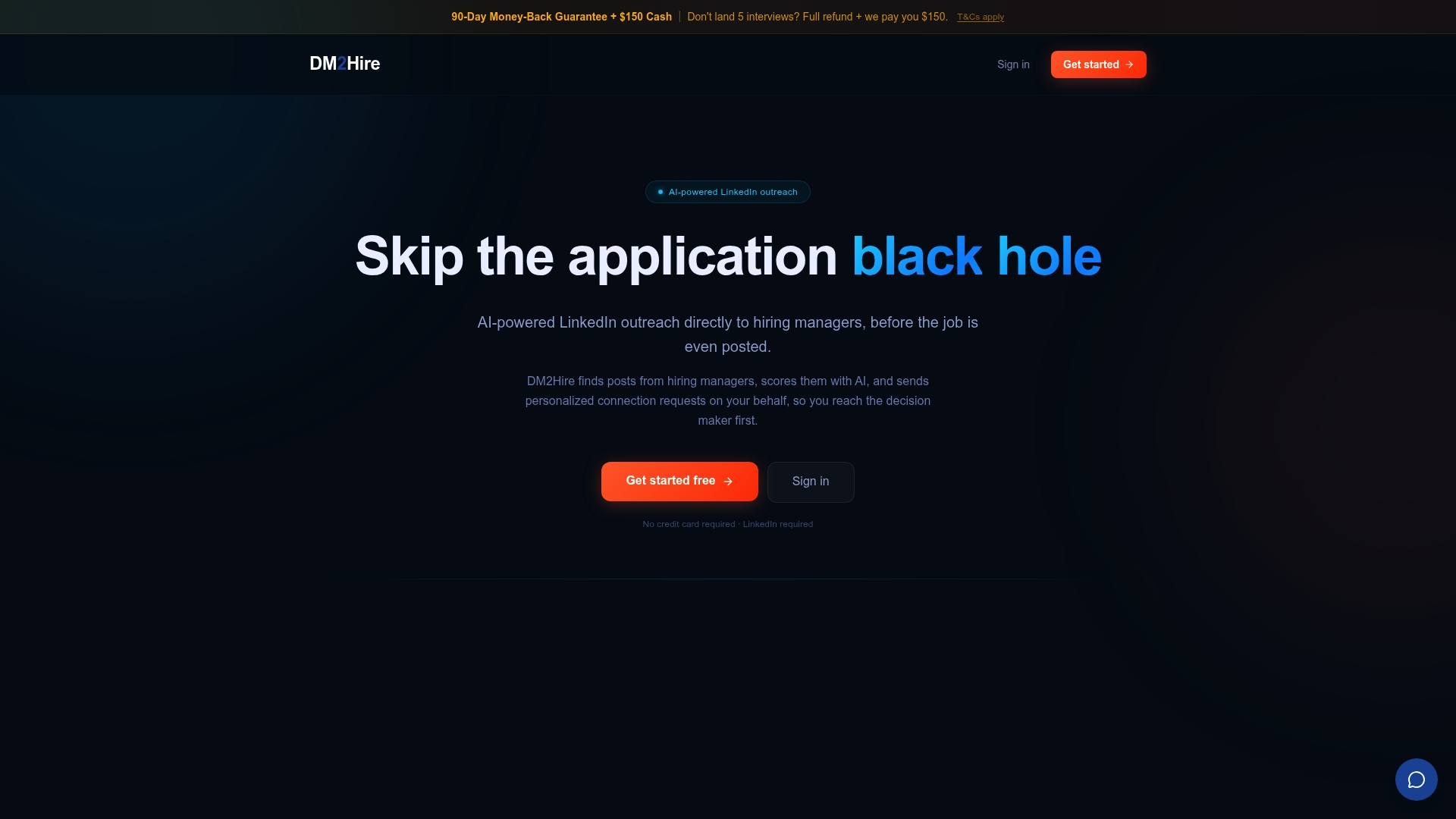
DM2Hire is an AI-powered LinkedIn outreach platform built specifically for professionals who want to reach hiring managers directly, without spending hours on manual research and messaging. You tell DM2Hire what roles you are targeting, and it scans LinkedIn daily for hiring managers and decision-makers posting about those roles. It scores each post for relevance, then generates personalized connection requests, direct messages, and comments tailored to what that person actually posted. You review and approve, or switch on Autopilot and let it run hands-free. Pair that with your own strategic commenting and you have a system that builds warm relationships at scale. Choose a DM2Hire plan that fits your search and start reaching the right people faster.
Frequently asked questions
How many comments should I make before connecting with a hiring manager on LinkedIn?
Aim for three to five substantive comments over four to six weeks to build enough context before sending a connection request. This gives the hiring manager time to recognize your name and associate it with credible input.
Can poorly worded LinkedIn comments hurt my job prospects?
Yes. Negative feedback perceived as belittling or humiliating often backfires and can damage how recruiters and hiring managers assess your interpersonal judgment and leadership presence.
Do recruiters actually check LinkedIn comments during hiring?
Some recruiters review candidates' public LinkedIn activity, including comments, as additional context for professionalism, communication style, and cultural fit, especially for senior roles.
Is commenting more effective than posting on LinkedIn for job seekers?
For mid-to-senior professionals, yes. Group-thread replies are three to five times more visible to recruiters than open feed posts, and targeted commenting has been shown to increase recruiter outreach by five to six times compared to posting-focused months.